The children have been doing wonderfully. It's an interesting topic to study with children who are at this math level, because on the one hand there are a lot of new concepts to assimilate (coordinate planes, axes, plotting coordinate points, even discussions of different dimensions), and on the other, the math skills required are not beyond anyone's reach. It's been challenging in some ways, but the kids have risen to the challenge. They've practiced finding coordinate points, drawing coordinate grids, finding the slope of various straight lines, and creating challenging slope problems for their classmates. With Jesse, they've measured the slope fo their own bodies in various positions. They've even begun speculating on what it would take to find the slope of a curved line... and that's gotten them all excited about studying calculus, one day!
Friday, May 6, 2011
Slope
In math, recently, I've been working with the children in both my math group and Jesse's on the concept of slope. This is not something that is covered in the Singapore books, and it came about because some of my students had questions about the section on parallel and perpendicular lines in the 4B books. I started explaining how to draw parallel lines on a grid... and then thought, "Why not take this just a little farther and really talk about coordinate grids and finding the slope of a line?" That line of thought took us farther than I expected, into the land of formulas and Greek symbols: Δy/Δx is now a familiar set of symbols in the classroom, and we all know that it stands for the change in y (subtracting one y coordinate point from another), divided by the change in x (subtracting the corresponding x coordinates). While I'm not good at figuring out how to type mathematical formulae, here is the formula as it's properly written:

Friday, April 29, 2011
Food science experiments
We have had some great experimental sessions this month, in and out of the kitchen. Here's a picture of one easy-to-duplicate science demonstration:
Having combined lots of baking soda and vinegar in a tank—thereby releasing a great deal of carbon dioxide—we saw that if you blow bubbles over the top of the tank, those that drift into the tank wind up resting, stationary, on a cushion of carbon dioxide. It creates a great chance to observe the bubbles more closely than is usually possible. In our discussion afterward, the children did an incredibly impressive job of applying their minds and their previous experience to the question of why, when two bubbles are joined together, the smaller bubble seems to push into the larger bubble. They figured out the right answer with hardly any help from me. Ask your child why it happens that way!
This morning, Zachary Williams came into the school (with our own Jesse, his co-mad scientist), and amazed us all by demonstrating electrolysis, separating out the hydrogen and oxygen gases in water. The children were fascinated, and so was I. After we'd finished with the electrolysis itself, Zach went on to demonstrate what happens when a match is inserted into a bottle full of hydrogen, or into a jar full of carbon dioxide. We have a melty soda pop bottle that we're keeping in the room as a souvenir. Don't try this one without supervision, anyone! (Full directions for the experiment, and safety tips, will be available on Jesse's blog: A Medley of Mathematics.)
And, this afternoon, we began an experiment for which we will need chicken bones. So, I picked up a couple of chickens from Whole Foods, and the children were responsible for extracting the bones. We're still working on it, but we had a lot of fun getting our hands dirty and seeing the inside of a bird this afternoon!
Thursday, April 21, 2011
Exquisite Corpse
There's a great writing exercise called "Exquisite Corpse" that the children and I have been having fun with in class recently. It's a group storytelling game, in which each child adds a sentence to a story. The sentences are written on a sheet of paper... but the catch is that the paper is folded down so that you can only see the single sentence just before your own. All earlier parts of the story are hidden, and that one sentence is all each student has to go on in understanding what the story is about. The results, of course, are often hilarious and unexpected.
After our first round of Exquisite Corpse, we took some time to discuss what makes a complete and proper sentence—according to our class's version of the game, each contribution must be a complete sentence. I copied one of the twelve stories we'd created onto the board and we all examined it, piece by piece, to see whether it was truly composed of complete sentences. The check marks on the left side of the blackboard indicate proper sentences. The checks on the right side of the board indicate whether or not each sentence follows logically from the one before—even if it bears no relation to previous sentences that the author couldn't see.
Once there was a man named Fran, who wanted to fly to Japan.
He did not have enough money and he needed a new job.
So he went to a school where people studied bones.
The school was a giant skeleton.
It was the skeleton of Elmo the stupid dragon.
The town took them.
Or, more accurately, the town stole them.
Then they sold them and spent all the money on apple pie.
They hated apple pie more than anything.
So they flew to space and ate cheese.
The End.
As you can see, we have some fun with these!
(For the curious, the name "Exquisite Corpse" apparently derives from an early round of the game, played by members of the Surrealist movement.)
Wednesday, March 30, 2011
Poetry month
Well, here we are wrapping up our poetry theme already! It seems like March has just flown by. Instead of choosing a particular poet or poem form on which to concentrate this month, the children and I have been exploring a variety of poetry ranging from "Jabberwocky" and its made-up words, to Middle English and its half-familiar words, to limericks and haiku. The children have been writing their own short poems—quatrains, limericks, haiku, and styles of their own choosing—and we'll be compiling the poems written by our class into a booklet for the children to take home.
Yesterday, we took a short walk through the County Farm Park to search for signs of spring. The season certainly isn't in its full bloom, yet, but the children spotted mud and grass, and even some more human signs of the season such as cyclists and the ash from a controlled burn in the park last week. Some of the seasonal haiku that the kids were writing today were especially beautiful, and gave me the chills when I read them. We're all waiting for warmer weather and flowers, but in the meantime, we're happy to see the sun.
We've also been on a few visits to Ann Arbor preschools, to share the Summers-Knoll poems "Salmon of the Sun" and "Moon Wolf" with the little ones. My students have loved the experience, I know, and the preschoolers were very excited to see such big, grown-up kids!
Thursday, March 10, 2011
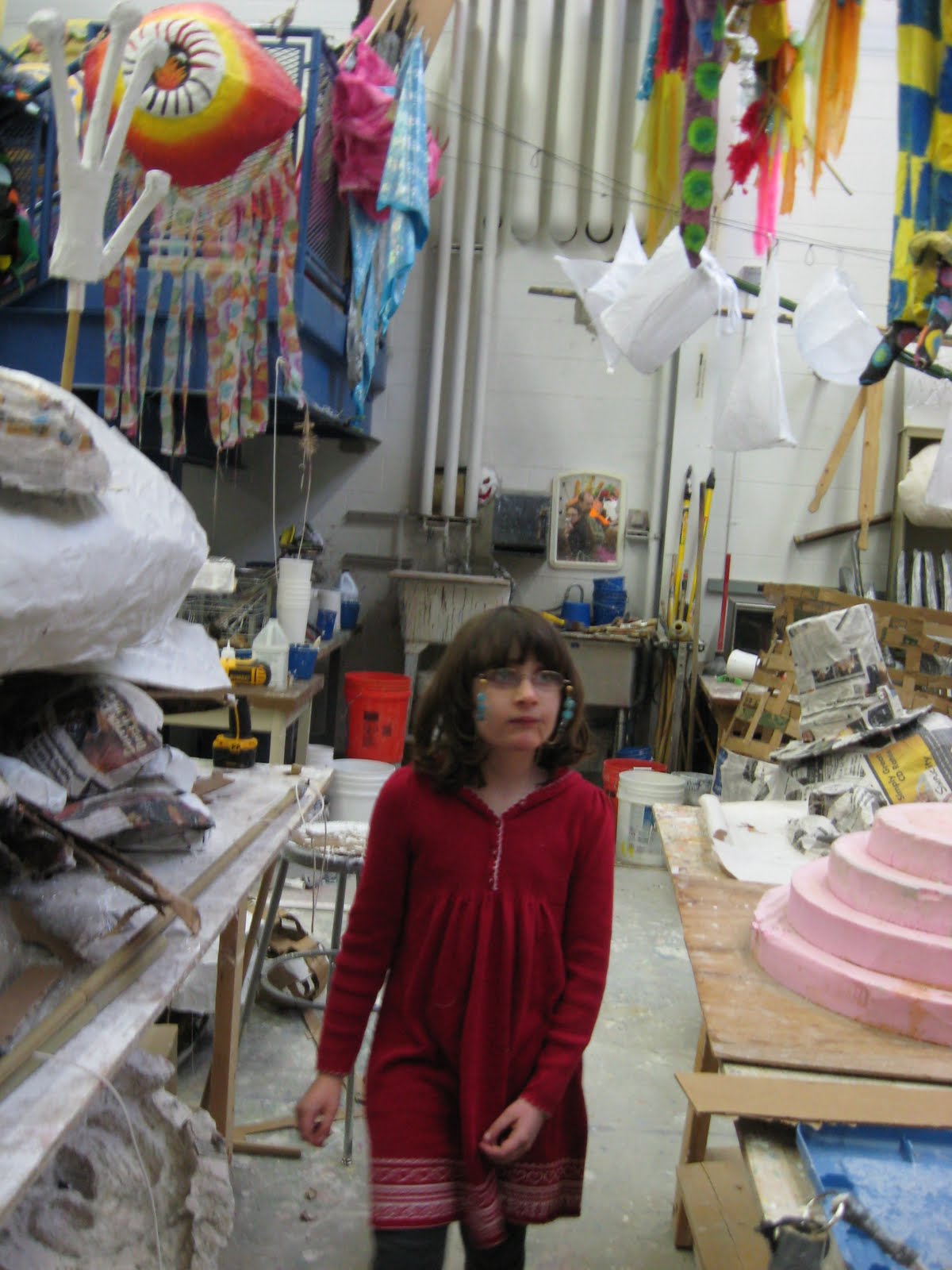
Festifools studio visit
Wednesday, March 9, 2011
Wednesday, March 2, 2011
Transitioning between themes
It is the first week of March! That means we switch it all up and start a new theme... but sometimes last month's theme isn't quite finished as the new month starts.
The old theme: simple machines. This week will culminate with our school-wide Invention Convention, and I'm hearing lots of great things from the kids about the inventions in progress (or already completed!) at home. In school, we're taking some time this week to work on big Rube Goldberg machines, in groups: the creativity and problem-solving that go into this—not to mention the teamwork—are beautiful to watch!
Here are some photos of the machines as they've come along:
The new theme: poetry! The kids and I had a fun discussion of "Jabberwocky" on Tuesday, identifying invented words and talking about onomatopoeia. As we move into this new month, we're going to explore all kinds of poems, and have lots of fun playing with language.
Subscribe to:
Posts (Atom)